
reflexions on Ashtanga after a Workshop with Gregor Maehler & Monica Gauci
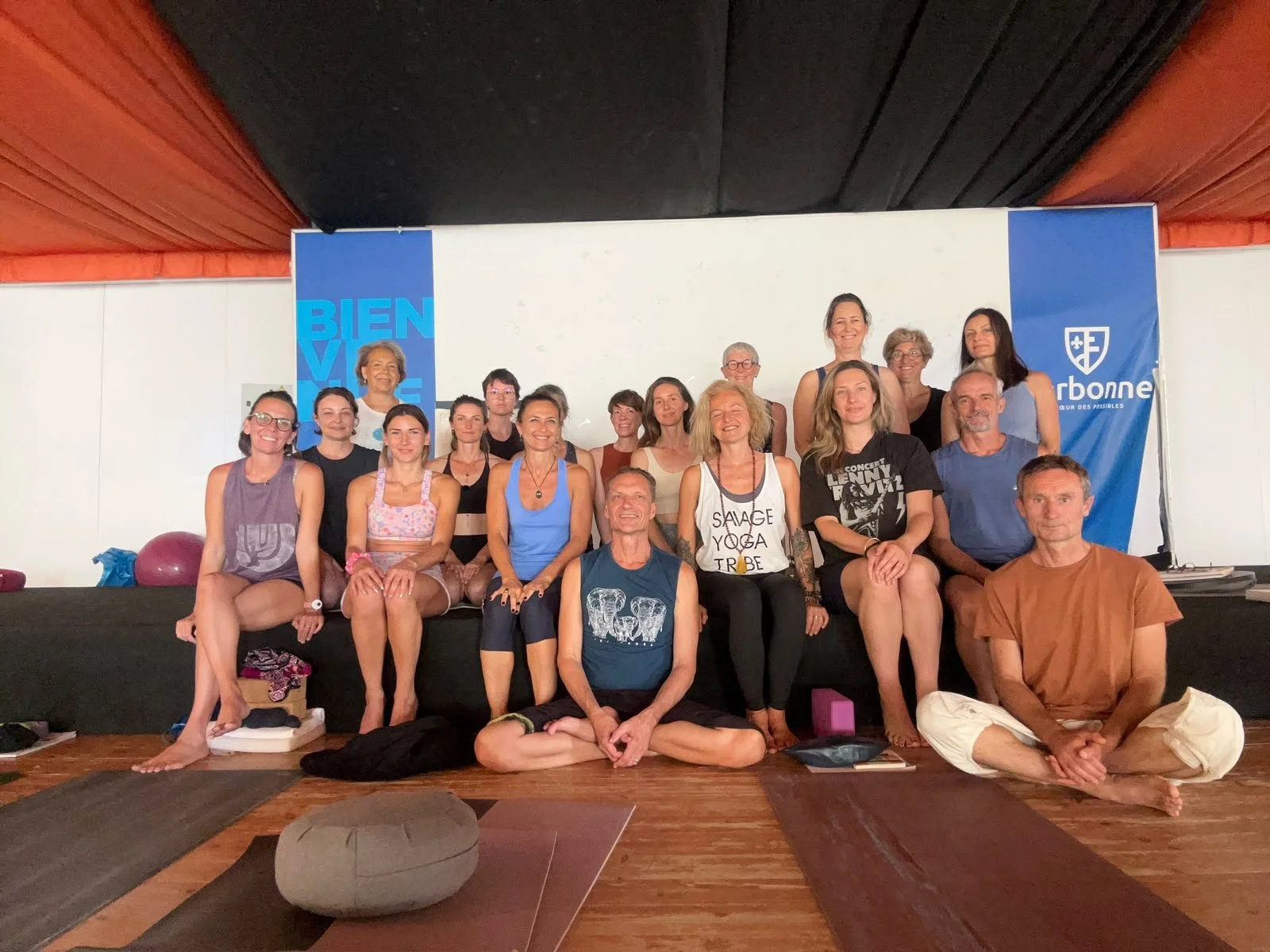
Last weekend, Amelia had the opportunity to attend a workshop with Gregor Maehler and Monica Gauci. It was an experience that left a strong impression on her, not because it introduced a completely new way of understanding Ashtanga Yoga, but because it reaffirmed something that has long been at the heart of Nydum's philosophy.
Throughout the weekend, Gregor and Monica presented an approach that honours the traditional structure of Ashtanga while gently releasing some of the rigidity that has often become associated with its lineage, particularly in the way it has been transmitted over the years. Rather than seeing the system as fixed and identical for every practitioner, they created space for observation, adaptation, and respect for individuality.
This balance between tradition and adaptability was woven throughout the entire workshop. Structure without rigidity. Discipline without uniformity. A framework that remains intact, while inviting every practitioner to discover their own expression, respond to their own needs, and respect their own limitations without judgment.
This became especially clear during the discussion around postures such as Lotus. In many traditional settings, there can be an implicit assumption that full Lotus is a destination every practitioner should eventually reach. During this workshop, however, the conversation was approached from a more nuanced and anatomically honest perspective.
One of the key reminders throughout the weekend was that the human body is not uniform. Variations in the coxofemoral joint, the angle of the femur, and the structure of the acetabulum all influence external rotation and hip mobility. As a result, two practitioners can dedicate the same amount of time, sincerity, and commitment to their practice, yet have completely different physical possibilities. For some, full Lotus may simply never be biomechanically available.
Rather than forcing the body towards a predetermined outcome, the invitation was to return to more foundational shapes, such as spending longer periods in Virasana, allowing the body to be met where it actually is, rather than where we think it should be.
For Amelia, this wasn't a new way of understanding the practice. At Nydum, respecting anatomical diversity and adapting the practice to the individual has always been a fundamental part of the way yoga is taught. Progress has never been measured by how closely someone matches an external ideal, but by the quality of awareness they cultivate through their own experience.
What made this workshop so meaningful was hearing these same principles expressed by teachers who come directly from the Ashtanga lineage. Listening to Gregor and Monica speak so openly about anatomical diversity, observation, and adaptation felt deeply reassuring. Rather than challenging Nydum's philosophy, their teaching reinforced it. It was a reminder that structure does not have to mean rigidity, and that discipline does not require uniformity.
The weekend also reinforced another important idea: honouring individuality does not weaken the tradition, it refines it. A practice that respects the uniqueness of each body remains true to its foundations while becoming more sustainable, more honest, and perhaps, above all, more compassionate.
Ultimately, the workshop served as a confirmation that the integrity of Ashtanga is not found in asking every practitioner to achieve the same shapes, but in preserving the essence of the practice while allowing each individual body to follow its own path. In that sense, yoga becomes less about reaching a final posture and more about understanding the intelligence of one's own body over time.